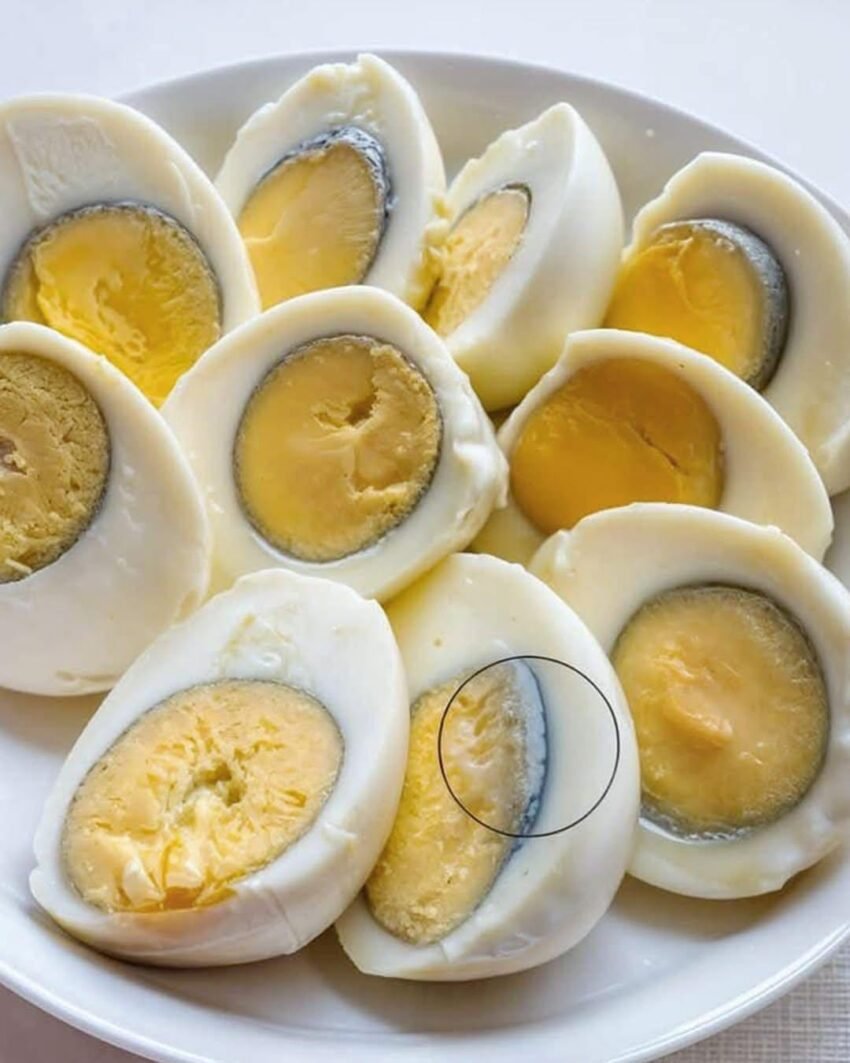
Absolutely! Let’s dive deep into why that green ring appears around an egg yolk:
1. What it looks like
- The greenish-gray ring forms around the yolk of a hard-boiled egg.
- It usually appears as a narrow band, sometimes more pronounced on older eggs or when eggs are overcooked.
- The yolk itself may still look slightly yellow in the center, but the outer ring is unmistakably greenish-gray.
2. The chemical cause
The green ring is caused by a reaction between sulfur and iron:
- Sulfur source:
- Egg whites are rich in sulfur-containing proteins.
- When heated, these proteins break down and release hydrogen sulfide gas (H₂S).
- Iron source:
- Egg yolks contain iron.
- Reaction:
- When H₂S from the white reaches the iron in the yolk, it reacts to form ferrous sulfide (FeS).
- FeS is what gives the yolk its greenish-gray edge.
3. Conditions that increase it
- Overcooking: The longer eggs are boiled, the more sulfur is released from the whites.
- High heat: Rapid boiling accelerates the reaction.
- Slow cooling: If eggs are left to cool slowly in hot water, the reaction continues longer.
- Older eggs: The yolk may be more prone to discoloration due to changes in pH over time.
4. How to prevent it
- Cook at the right temperature: Boil gently rather than vigorously.
- Time it carefully: Typically, 9–12 minutes is enough for large eggs.
- Cool quickly: Transfer eggs to ice water immediately after boiling to stop the reaction.
- Use fresher eggs: Fresher eggs have a lower pH, which reduces the reaction rate.
5. Safety
- The green ring is not harmful.
- It may slightly alter the texture, making the yolk more dry or chalky at the edges.
- Nutritionally, the egg is still completely safe to eat.
If you want, I can also explain why the ring sometimes appears yellowish or even has a rainbow tint, which is even subtler chemistry! 🌈🥚
Do you want me to go into that too?
