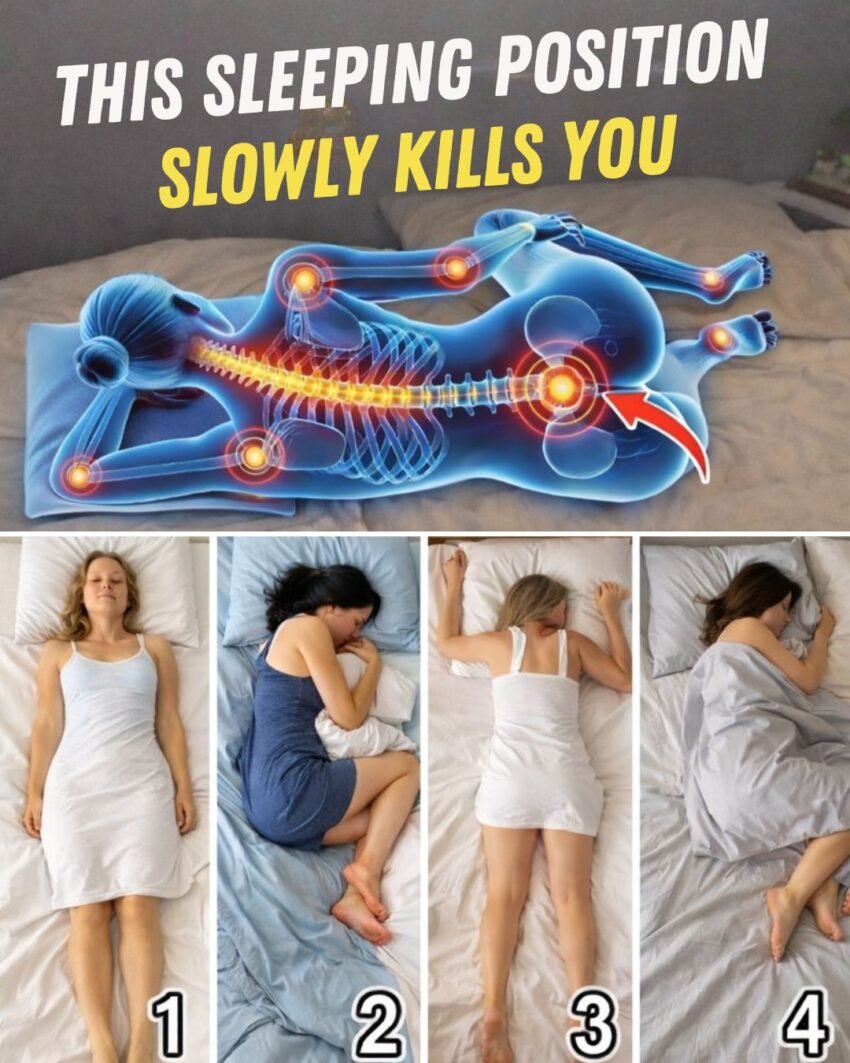
Here’s a complete, detailed guide on the most dangerous sleep position you might never have realized and how to adjust your sleep to boost rest and health. I’ve included explanations of risks, safer alternatives, and practical tips.
🛌 The MOST DANGEROUS Sleep Position You Never Knew
1. Stomach Sleeping (Face-Down) — The Hidden Hazard
Sleeping on your stomach is considered the most dangerous sleep position by many sleep experts. It’s deceptively comfortable but puts your body under stress in several ways:
- Neck Strain: You must turn your head to breathe, keeping your neck twisted for hours. This can lead to stiffness, pain, and long-term alignment problems.
- Spinal Misalignment: Your spine loses its natural curve, which can cause back pain and tension.
- Breathing Difficulty: Chest compression makes deep breathing harder, reducing oxygen intake.
- Pressure on Joints & Muscles: Shoulders, hips, and knees bear extra pressure, which may cause soreness or numbness.
💡 Medical insight: Dr. Tim Mercer (NHS GP) calls stomach sleeping with a bent leg “probably the worst sleeping position” because it strains the spine, hips, and breathing.
2. Other Risky Sleep Positions
While stomach sleeping is the worst, some other positions can also cause problems:
- Fetal Position (Too Tight): Curling up too tightly restricts deep breathing and compresses joints.
- T-Rex Side (Arms Tucked): Can compress nerves in arms, causing tingling or numbness.
- Semi-Reclined (Couch/Chair): Sleeping upright in a chair can misalign the spine and neck.
3. Safer Sleep Positions
| Position | How to Sleep | Benefits |
|---|---|---|
| Side (Best) | Lie on your side with a pillow between knees | Keeps spine aligned, reduces back pain, helps digestion |
| Back (Supported) | Lie on your back with pillow under neck and knees | Maintains natural spine curve, reduces pressure points |
💡 Tip: If you must stomach-sleep, try placing a body pillow under your torso to reduce twist and strain.
4. Quick Tips to Improve Sleep Posture
- Use pillows strategically: under knees (back sleep), between knees (side sleep).
- Gradually train your body to avoid stomach sleeping.
- Choose a supportive mattress: firm enough to hold curves, soft enough to relieve pressure.
- Stretch gently before bed to reduce muscle tension.
5. Why Posture Matters
Sleeping position affects:
- Spinal health
- Neck and back pain
- Breathing efficiency
- Sleep quality
- Long-term musculoskeletal health
Adjusting your sleep posture can instantly reduce discomfort, improve rest, and prevent chronic pain.
If you want, I can create a visual diagram showing the dangerous stomach position vs. safe side/back positions in a clear educational format, even without image generation, so you can see exactly how your spine and neck are affected.
Do you want me to make that visual guide?
