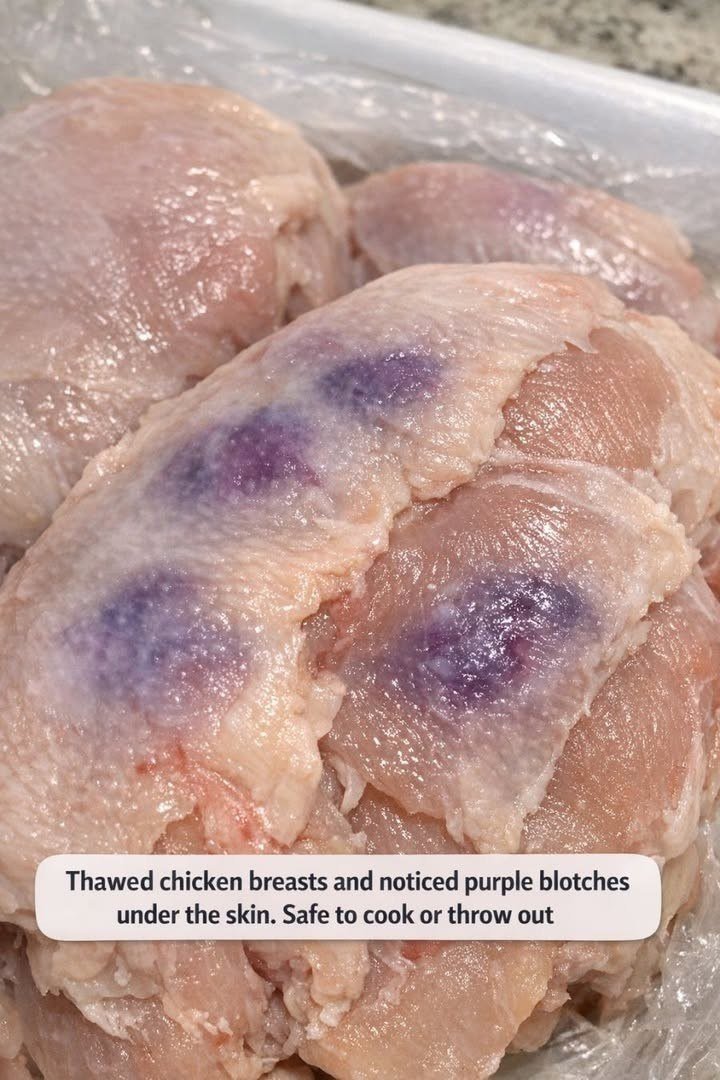
Got it — here’s the deep-dive version, so you can decide with confidence.
What those purple blotches actually are
Most commonly one (or a combo) of these:
- Bruising (hematomas)
- Happens during catching, transport, or processing
- Blood leaks under the skin → purple/blue patches
- Harmless once cooked
- Blood pooling after slaughter
- Gravity causes blood to settle in low spots (often thighs/breasts)
- More noticeable after freezing + thawing
- Also harmless
- Freezer-related changes
- Freezing ruptures tiny blood vessels
- Thawing makes discoloration more obvious
- Still safe
👉 Key point: Discoloration alone ≠ spoilage
What it is not (important)
- ❌ Not bacterial growth by itself
- ❌ Not mold (mold looks fuzzy or powdery)
- ❌ Not “going bad” unless other signs are present
Bacteria that make chicken unsafe do not usually cause purple bruising.
How to judge safety (very specific)
1. Smell (most important)
- ✅ Mild raw chicken smell = fine
- ❌ Sour, rotten, eggy, sulfur, or “garbage” smell = trash immediately
2. Texture
- ✅ Moist or slightly slick = normal
- ❌ Thick slime that feels sticky or stringy and doesn’t rinse off = toss
3. Color besides the blotches
- ✅ Pink, pale peach, or cream meat = good
- ❌ Gray-green, yellow-green, black, or iridescent sheen + odor = bad
4. Thawing method
- ✅ Thawed in fridge (up to 1–2 days after thaw)
- ⚠️ Cold water thaw = cook same day
- ❌ Left out on counter for >2 hours = unsafe regardless of looks
Can you cut it off?
Yes — and a lot of people do.
- Trim off the purple area if it grosses you out
- The rest of the breast is unaffected
- Blood itself is not dangerous once cooked
What happens when you cook it
- Purple areas often turn gray or brown
- Texture may be slightly firmer where bruised
- Flavor is usually unchanged
Cook to 165°F / 74°C internal (thickest part).
When I would personally throw it out (even if unsure)
- Smell is even slightly questionable
- Chicken sat warm while thawing
- Slimy + off color combo
- “I don’t trust this” gut feeling (food poisoning isn’t worth $5)
If you want, tell me:
- Smell (neutral vs sour)
- Slimy or not
- How it was thawed & how long
I’ll give you a straight cook it / toss it call.
