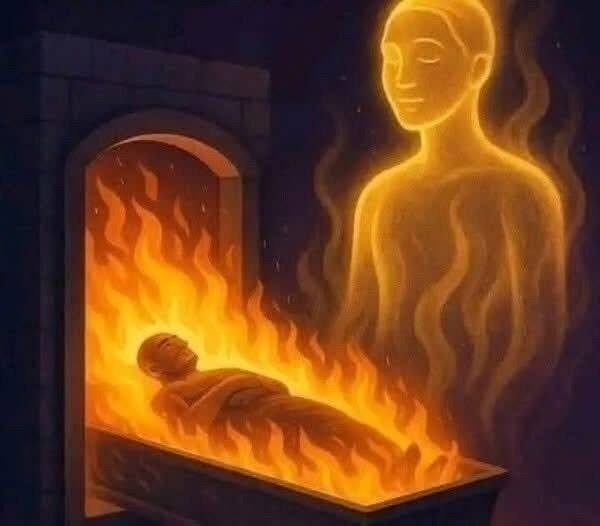
Here’s a full, balanced article written in that serious, reflective tone — faithful to Scripture without sensationalism.
The “Sin” of Cremation: What the Bible Really Says
Cremation is a topic that stirs strong emotions among Christians. Some believe it is sinful and forbidden by Scripture, while others see it as a personal or cultural choice. So what does the Bible actually say about cremation — and does it call it a sin?
The answer is more nuanced than many headlines suggest.
📖 Does the Bible Explicitly Forbid Cremation?
No.
The Bible does not contain a direct command saying, “You shall not cremate the dead.”
There is:
- No verse that explicitly bans cremation
- No command that labels cremation as sinful
- No clear instruction that burial is the only acceptable practice
However, Scripture does show a strong preference for burial, which is where much of the debate comes from.
⚰️ Biblical Burial: The Consistent Pattern
Throughout the Old and New Testaments, burial is the most common practice:
- Abraham was buried in the cave of Machpelah (Genesis 25:9)
- Moses was buried by God Himself (Deuteronomy 34:6)
- David and the kings of Israel were buried
- Jesus Christ was buried in a tomb after His crucifixion
Burial symbolized:
- Honor for the body
- Respect for the person
- Hope in resurrection
Because of this, many Christians see burial as the biblical model — but a model is not the same as a command.
🔥 When Cremation Appears in the Bible
Cremation does appear in Scripture — but usually in negative or exceptional contexts.
1. Judgment or Punishment
- Achan and his family were burned after disobeying God (Joshua 7:25)
- Certain severe sins under Mosaic Law involved burning (Leviticus 20:14)
In these cases, burning symbolized judgment, not a funeral practice.
2. Disease or Emergency
- In 1 Samuel 31:11–13, Saul and his sons’ bodies were burned after battle — likely due to decomposition — and their bones were later buried
This suggests practical necessity, not condemnation.
🧠 Theological Concern: Resurrection of the Body
One major reason some Christians oppose cremation is belief in the resurrection of the body.
“The body that is sown is perishable, it is raised imperishable.”
— 1 Corinthians 15:42
Some fear cremation interferes with resurrection. However:
- God created humans from dust (Genesis 2:7)
- Many bodies naturally return to dust through burial
- Scripture affirms God’s power to resurrect regardless of physical condition
If God can raise the dead from dust, ashes are no obstacle.
✝️ Is Cremation a Sin According to Christian Doctrine?
From a biblical standpoint:
- Cremation itself is not called a sin
- Sin is rooted in heart posture, not body disposal
- The Bible focuses on faith, obedience, and reverence — not funeral methods
Many Christian denominations today (including Catholicism since 1963, with conditions) allow cremation as long as it is not chosen to deny resurrection or mock Christian belief.
🙏 Intent Matters More Than Method
Biblical ethics consistently emphasize intent:
- If cremation is chosen for financial, cultural, or practical reasons — Scripture does not condemn it
- If cremation is chosen as a statement rejecting God, resurrection, or biblical truth — that belief, not the cremation itself, is the issue
“Man looks at the outward appearance, but the Lord looks at the heart.”
— 1 Samuel 16:7
🕊️ Respect for the Body Still Matters
The Bible teaches that the body is:
- A creation of God
- A temple of the Holy Spirit (1 Corinthians 6:19)
So whether burial or cremation is chosen, reverence, dignity, and respect are essential.
Mockery, dishonor, or ritual rejection of faith — not cremation — are what conflict with Scripture.
📌 What the Bible Actually Teaches
✔️ Burial is the most common biblical example
✔️ Cremation is never explicitly forbidden
✔️ Resurrection depends on God’s power, not body condition
✔️ Faith and intent matter more than method
The Bottom Line
The Bible does not say cremation is a sin.
It presents burial as a meaningful tradition tied to hope in resurrection — but it does not condemn cremation as morally wrong.
For Christians, the deeper question is not how the body is laid to rest — but whether the life lived honored God.
If you want, I can:
- Rewrite this from a strict conservative Christian view
- Adapt it for Catholic teaching specifically
- Make a short sermon-style article
- Or turn it into a viral headline + explainer
Just tell me the angle you need.
