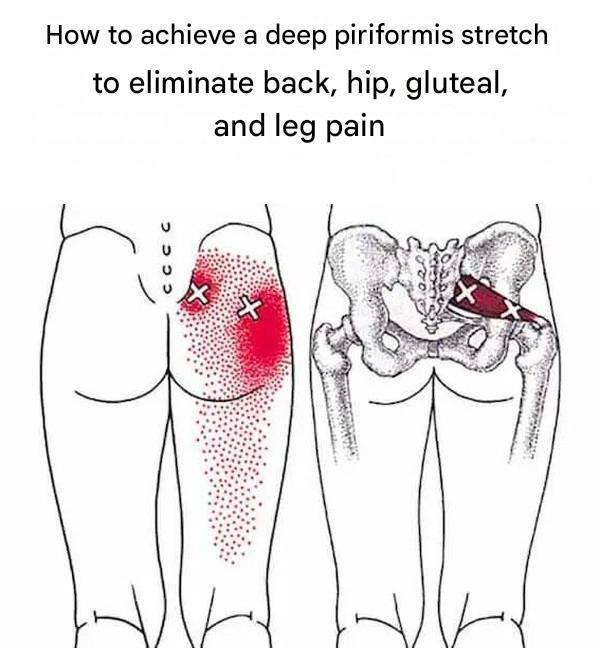
Absolutely! The piriformis muscle, located deep in the buttock, can compress the sciatic nerve if tight, causing lower back, hip, gluteal, and leg pain (often called piriformis syndrome). Stretching it correctly can provide significant relief, but because it’s deep, proper technique is crucial. Here’s a comprehensive guide:
🔹 Key Principles for a Deep Piriformis Stretch
- Warm up first – gentle walking or light hip movements for 5–10 minutes. Cold muscles are harder to stretch and more prone to injury.
- Focus on the hip, not the back – the goal is to rotate and open the hip. Avoid overarching your lower back.
- Breathe deeply – tension in the body tightens the piriformis. Slow exhalation helps deepen the stretch.
- Hold, don’t bounce – aim for 30–60 seconds, repeat 2–3 times per side.
- Progress gradually – don’t force pain; mild discomfort is okay, sharp pain is not.
🔹 Most Effective Piriformis Stretches
1. Figure-Four Stretch (Seated or Lying)
- Lying on your back:
- Cross your right ankle over your left knee (like a “4” shape).
- Grab the back of your left thigh and gently pull it toward your chest.
- Keep your head and shoulders relaxed on the floor.
- Tip: Keep your lower back on the floor; don’t let it arch.
- Duration: 30–60 sec each side
2. Supine Piriformis Stretch with Rotation
- Lie on your back.
- Bend both knees and place feet flat.
- Cross your right ankle over left knee.
- Slowly rotate your hips so your right knee moves away from your body while keeping the left hip grounded.
- This adds a deep rotational component that targets the piriformis more intensely.
3. Pigeon Pose (Yoga Stretch)
- From a plank or downward dog, bring your right knee forward and place it near your right wrist.
- Extend your left leg straight back.
- Square your hips forward, lean slightly over the bent leg.
- Tip: If you feel knee discomfort, support the bent leg with a blanket.
- This is intense and deep, but highly effective for the piriformis and glutes.
4. Seated Piriformis Stretch
- Sit tall on a chair.
- Cross your right ankle over your left knee.
- Keep your back straight and hinge forward at the hips until you feel a deep stretch in the right buttock.
- This is gentle but effective for daily use, especially if you sit for long periods.
5. Foam Roller / Ball Release
- Sit on a foam roller or tennis/lacrosse ball placed under the piriformis/gluteal area.
- Gently shift weight to roll the tight spots.
- Hold on tender areas for 20–30 sec to relax the muscle.
- Tip: Combine with deep breathing to release tension.
🔹 Additional Tips for Relief
- Stretch daily – 2–3 times per day if symptoms are significant.
- Strengthen opposing muscles: glute medius, core, and hip external rotators help prevent re-tightening.
- Heat therapy – a warm compress before stretching helps muscle relaxation.
- Check posture – prolonged sitting with crossed legs can worsen tightness.
- Physical therapy – if pain persists or radiates down the leg, a PT can teach nerve glides, strengthening, and deep tissue release safely.
✅ Caution: If you experience sharp shooting pain, numbness, tingling down the leg, or worsening back pain, stop and consult a medical professional to rule out disc issues or sciatica.
If you want, I can create a step-by-step 10-minute daily routine that targets the piriformis, glutes, hips, and lower back for fast relief and long-term prevention. It’s very effective for chronic tightness. Do you want me to do that?
