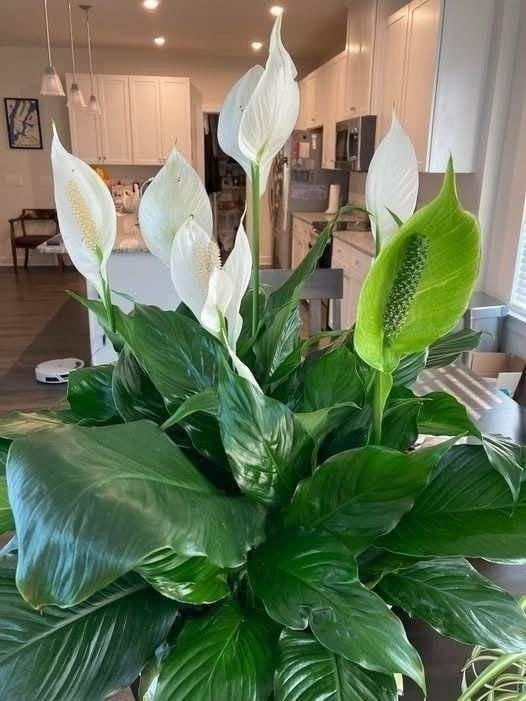
Getting a peace lily (Spathiphyllum) to flower more often can be tricky because flowering depends on light, nutrition, and care conditions. Here’s a detailed, step-by-step guide to encourage your peace lily to bloom more frequently:
1. Provide the Right Light
- Peace lilies flower more with bright, indirect light.
- Avoid direct sunlight — it can scorch the leaves.
- If your plant is mostly green with few blooms, it may not be getting enough light.
- Tip: A spot near an east- or north-facing window is ideal. If only low light is available, consider supplementing with fluorescent or LED grow lights for 8–10 hours a day.
2. Proper Watering
- Peace lilies like consistently moist soil, but not soggy.
- Water when the top 1–2 inches of soil feels dry.
- Avoid letting the plant sit in water — standing water can cause root rot.
- They are sensitive to chlorine or fluoride in tap water, which can brown the leaf tips. Use filtered, distilled, or rainwater if possible.
3. Humidity
- High humidity encourages blooming.
- Ideal humidity is 50% or higher.
- If your home is dry:
- Mist the leaves regularly.
- Place the pot on a tray of pebbles with water (keeping the pot slightly above the water).
- Use a room humidifier.
4. Fertilization
- Use a balanced, water-soluble fertilizer (20-20-20 or 10-10-10) every 6–8 weeks during the growing season (spring and summer).
- Tip: Too much fertilizer, especially high in nitrogen, promotes leaves but reduces flowering.
- Consider a fertilizer higher in phosphorus (like 10-30-10) to encourage blooms.
5. Repotting
- Peace lilies flower better when slightly root-bound, but if roots are severely cramped, it can reduce flowering.
- Repot every 1–2 years into a pot only slightly larger than the root ball.
- Use a well-draining potting mix rich in organic matter.
6. Encourage Blooming
- Trim old blooms: Cut off faded white spathes at the base to encourage new ones.
- Temperature: Keep temperatures between 65–85°F (18–29°C); avoid drafts and sudden drops below 60°F.
- Stress method: Slightly reducing water for a short period can sometimes trigger flowering, but do this cautiously — peace lilies are sensitive.
7. Patience
- Peace lilies naturally bloom once or twice a year, typically in spring.
- With optimal care, flowers may last 6–8 weeks, and the plant may produce multiple blooms over the season.
✅ Summary:
- Light: bright, indirect
- Water: consistent, avoid standing water
- Humidity: high
- Fertilizer: balanced or slightly phosphorus-rich, moderate amounts
- Repotting: slightly root-bound is good
- Trim spent flowers and maintain steady temperatures
If you want, I can make a month-by-month care schedule for a peace lily that maximizes bloom frequency — basically a “flowering calendar” so it blooms almost year-round.
Do you want me to do that?
