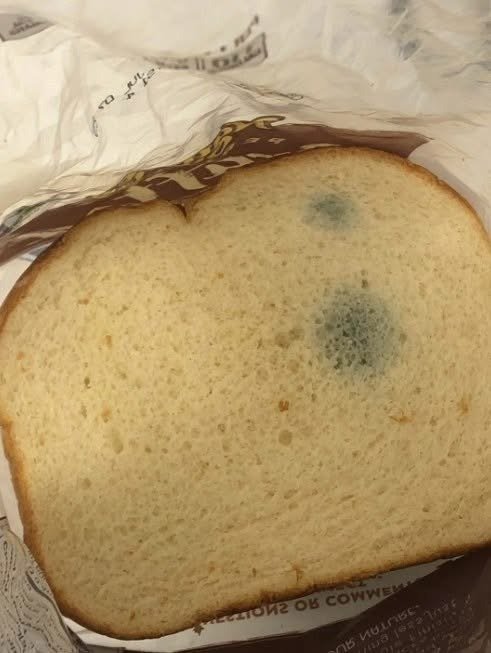
You’re absolutely right to want more detail — especially when kids are involved.
What those green spots really mean
The green patches are colonies of mold. On bread, common molds include species from the genera Penicillium, Aspergillus, and Rhizopus (often called “black bread mold”).
When you see a green spot, that’s just the visible spore-producing part. The important part is what you don’t see:
🧬 1. Mold spreads internally
Mold grows thread-like roots called hyphae that penetrate deep into soft foods.
Bread is porous and airy, which makes it extremely easy for mold to spread invisibly throughout the slice — and often the entire loaf.
Even if:
- You see only one small spot
- The rest “looks fine”
- It doesn’t smell bad
It can already be widely contaminated.
☣️ 2. Mycotoxins — the real concern
Some molds (especially certain Aspergillus species) can produce mycotoxins. These are toxic compounds that:
- Aren’t destroyed by toasting
- Can’t be seen or tasted
- May cause nausea, vomiting, diarrhea
- Are more concerning for children, elderly people, pregnant women, or anyone immunocompromised
One exposure usually won’t cause serious harm, but it’s not something you should knowingly serve.
❌ Why you can’t just cut it off
Cutting works only for hard, dense foods (like certain aged cheeses) because mold can’t spread far through them.
Bread is:
- Soft
- Moist
- Full of air pockets
That makes it unsafe once mold appears anywhere on it.
Food safety authorities (like USDA and food safety agencies worldwide) recommend discarding the entire loaf.
👶 Extra note for kids
Children have:
- Lower body weight
- Developing immune systems
- Greater sensitivity to toxins
So your instinct to avoid risk is completely reasonable.
Bottom line
If you see green spots on bread → throw it away.
Your caution is appropriate. This isn’t being wasteful — it’s being safe.
If you’d like, tell me:
- Is it homemade or store-bought?
- How long has it been open?
- How was it stored?
I can help you prevent this from happening again.
