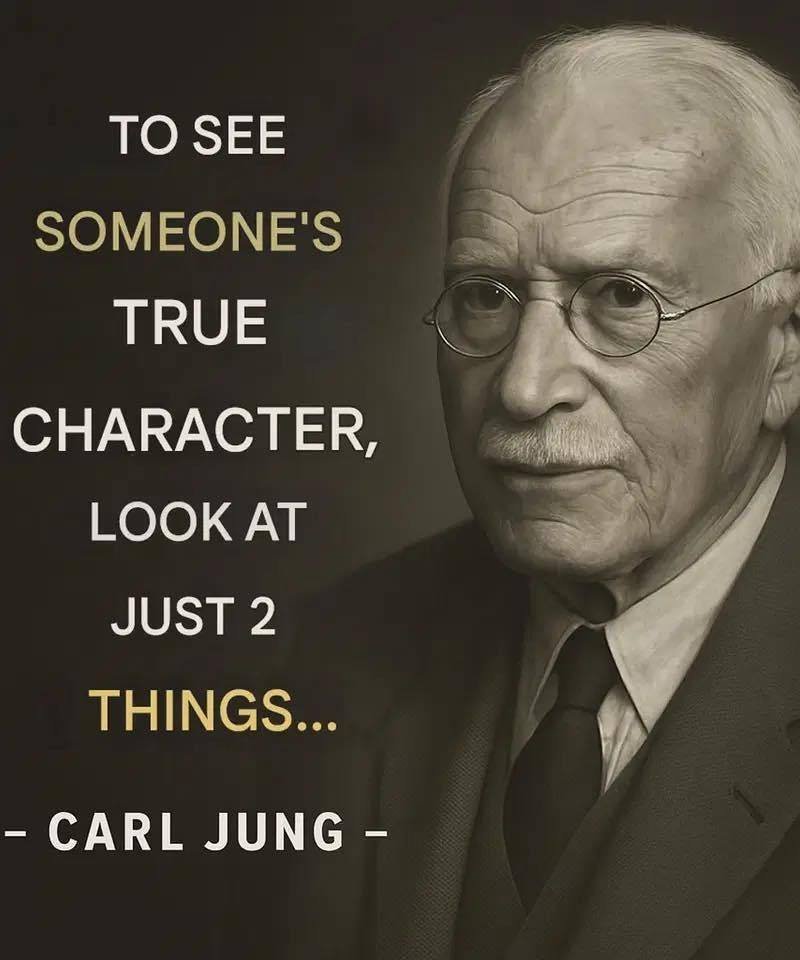
There is a popular video and social‑media idea circulating that attributes to Carl Jung a kind of psychological test for seeing someone’s “true character” by focusing on just two things. However, it’s important to clarify what’s verifiable and what comes from Jung’s actual psychological theory versus online interpretations. (Recapio)
🧠 The Two Questions Often Attributed to Jung
According to a transcript summarizing a video attributed to Jung’s ideas (but not directly from Jung’s published works), the two questions are:
- “What kind of person can you absolutely not stand?”
- “Tell me about a situation where you were absolutely certain you were right and then it turned out you were wrong.”” (Recapio)
🔍 Why These Questions Reveal Character (According to the summary)
- They bypass surface personas. People often present a socially acceptable “mask” (persona), but these questions prompt deeper, less guarded responses.
- The first question explores the shadow. Jung’s concept of the shadow refers to the parts of ourselves we reject or deny — and what we most dislike in others often mirrors what we disown in ourselves.
- The second question probes ego and humility. How people respond when confronted with their own fallibility can reveal resilience, defensiveness, or self-awareness. (Recapio)
However, these questions aren’t found in Jung’s original texts — they appear in videos that interpret Jung’s work through a modern motivational lens. So treat them as inspired by Jungian thought rather than as a literal Jung quote.
🧠 Jung’s Genuine Psychological Framework
To evaluate someone’s true character in a Jungian sense, we need to understand two key ideas he did write about:
🔹 1. Persona vs. Shadow
Jung described the persona as a social mask — the part of personality we show the world — and the shadow as the unconscious part we deny or repress. (Wikipedia)
- The persona is what people want others to see.
- The shadow contains traits people deny, often projecting them onto others.
- The deeper and more conscious someone is of their shadow, the more integrated and authentic their character tends to be.
- People who cannot acknowledge their flaws often project them outwardly — which can reveal more about their inner conflicts than about external reality. (Eternalised)
🔹 2. Projection and Reaction
Jung believed that how we react to others often reveals our own unconscious content:
- If someone reacts strongly with dislike to particular traits in others, this may reflect disowned aspects of themselves.
- People with mature characters tend to integrate their shadow material rather than deny or project it. This integration fosters psychological balance. (Bathtub Bulletin)
📌 Summary: What Really Reveals True Character (in Jungian Terms)
Rather than two neat rules, Jung’s work suggests these deeper indicators:
🔸 How a person handles their own unconscious
- Do they acknowledge weaknesses or deny them?
- Are they defensive or open to personal growth?
🔸 How they respond to others’ flaws
- Do they project their own unconscious material onto others?
- Can they empathize without judgment?
In essence, Jung’s analytical psychology encourages observing how people deal with hidden parts of themselves — not just how they act outwardly — to understand true character. (Wikipedia)
⚠️ Important Note on Attribution
Many quotes and “two questions” lists circulating online claim Jung said them — but they are not found in his published works. They are interpretations or summaries inspired by Jungian psychology, not literal quotes. (reddit.com)
If you’d like, I can also point you to specific original works by Jung (e.g., Collected Works, Memories, Dreams, Reflections) where he discusses the persona, shadow, and individuation in his own words. Would that help?
