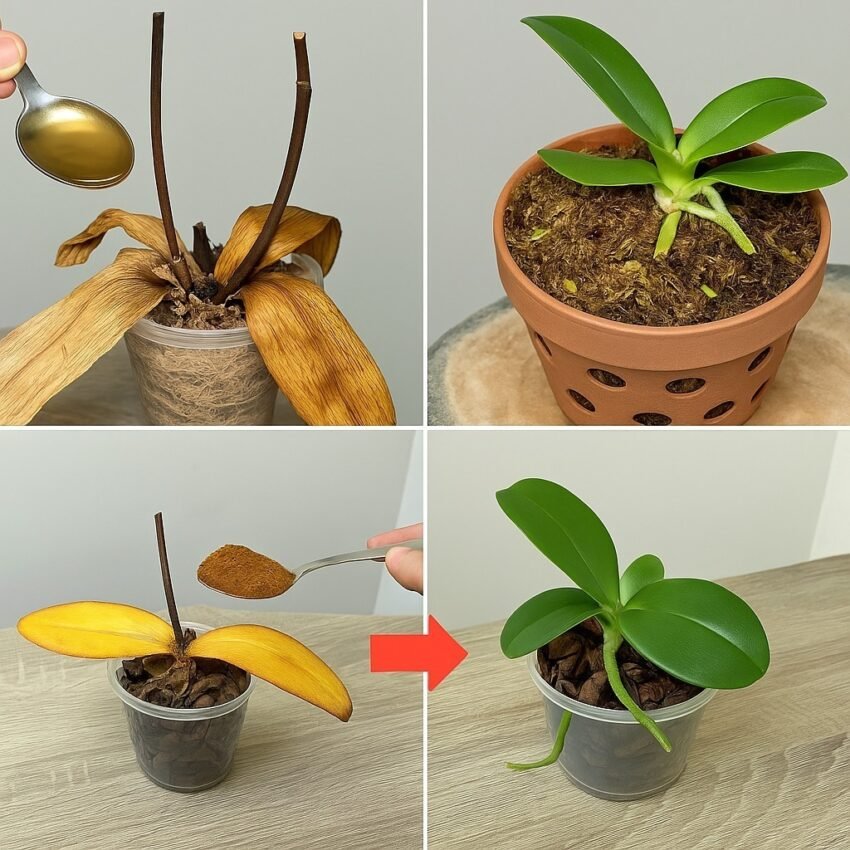
That kind of claim is a bit misleading—if orchid roots are truly dead (dry, hollow, mushy, or rotten), nothing you sprinkle on top will “revive” them. However, you can help a struggling orchid recover and grow new roots with the right care.
🌿 The “1 spoon trick” people talk about
Usually this refers to cinnamon powder.
What it actually does:
- Cinnamon acts as a natural antifungal.
- It helps protect cut or damaged roots from rot and infection.
- It does not regrow dead roots or magically make orchids bloom nonstop.
🌸 How to properly revive an orchid (the real method)
1. Check the roots
- Healthy roots = firm and green/silver
- Dead roots = brown, mushy, hollow → these should be trimmed
2. Prune damaged roots
- Use clean scissors
- Remove all rotten parts
- Lightly dust cut areas with cinnamon (this is where the “1 spoon” idea fits)
3. Repot correctly
- Use fresh orchid bark (not regular soil)
- Ensure good drainage and airflow
4. Water properly
- Water only when roots turn silvery
- Avoid constant wetness (main cause of root rot)
5. Give the right conditions
- Bright, indirect light
- Good humidity
- Occasional orchid fertilizer (very diluted)
🌼 About “blooms all year round”
Most orchids—especially Phalaenopsis orchid—naturally bloom once or twice a year, not continuously. With good care, blooms can last for months, but nonstop flowering isn’t realistic.
✔️ Bottom line:
Cinnamon can help protect an orchid after pruning, but it won’t bring dead roots back to life. Recovery comes from proper care, not a single ingredient.
If you want, tell me what your orchid looks like (roots/leaves), and I can help you diagnose it step-by-step.
