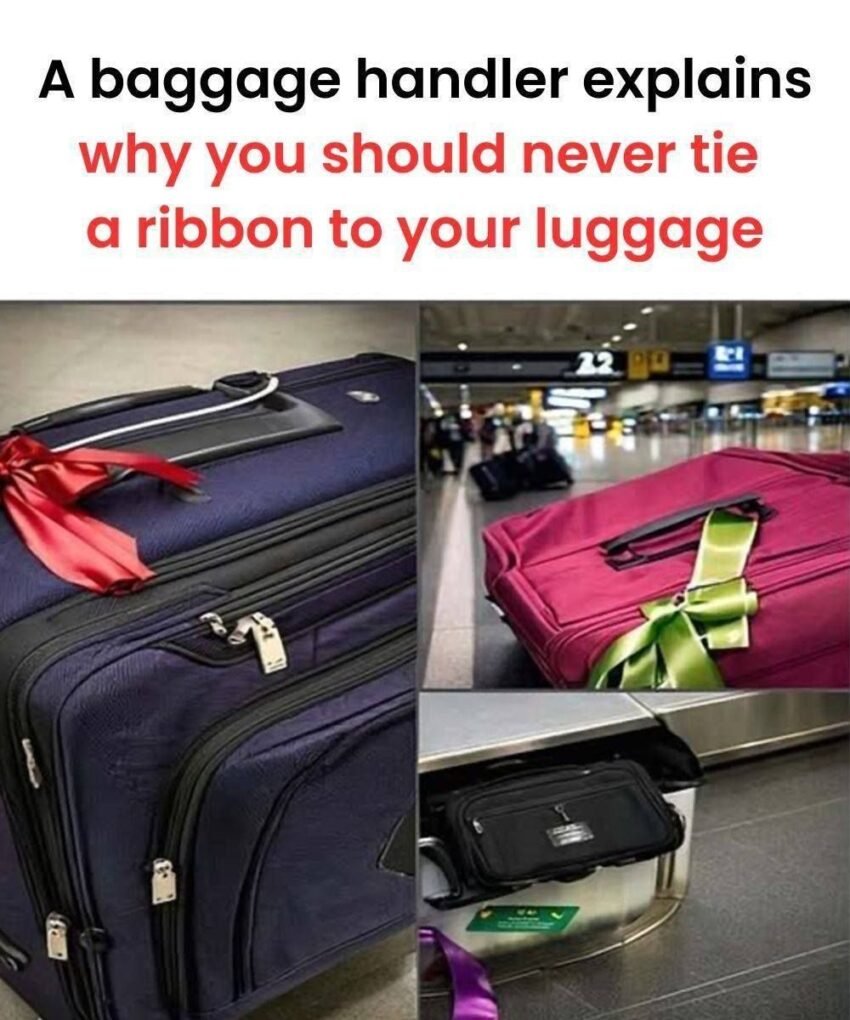
Here’s the inside-the-belt explanation, straight from how airport baggage systems actually work—and why handlers quietly hate ribbons.
Why baggage handlers say: don’t tie ribbons to your luggage
1. Modern airports don’t rely on humans to spot your bag
Most large airports use automated baggage handling systems (BHS):
- Conveyor belts
- High-speed diverters
- Optical scanners
- RFID and barcode readers
Your suitcase is identified by a flat, unobstructed baggage tag, not by visual markers like ribbons.
When you add a ribbon, you’re introducing something the system was never designed to handle.
2. Ribbons cause bags to jam — a lot
Loose items (ribbons, straps, scarves) can:
- Get caught in conveyor rollers
- Wrap around spinning axles
- Trigger emergency shutdowns
- Tear off and lodge inside machinery
When that happens:
- The entire belt may stop
- Hundreds of bags get delayed
- Your bag is pulled for manual inspection
- And guess which bags are most likely to miss the flight?
👉 The “problem” ones with extra stuff attached
Handlers see this daily.
3. Your bag may be diverted for manual processing
If a scanner detects:
- Obstructed tags
- Irregular shapes
- Dangling materials
Your luggage is flagged as non-standard and kicked out of the automated line.
Manual handling means:
- Slower processing
- More handoffs
- Higher chance of misrouting
- Higher chance it doesn’t make your plane
Ironically, the ribbon meant to “help identify” your bag often causes it to arrive later.
4. Ribbons interfere with barcode & RFID scans
Baggage tags must be:
- Flat
- Visible
- Aligned
A ribbon tied near the handle can:
- Flip the tag
- Cover the barcode
- Block RFID transmission
If the scanner can’t read the tag instantly, the system doesn’t guess—it rejects the bag.
5. Handlers don’t need visual cues
This surprises people.
Baggage handlers:
- Don’t look for ribbons
- Don’t match bags to passengers
- Don’t “recognize” your suitcase
They load based on:
- Container numbers
- Destination codes
- Automated sorting
A pink ribbon means nothing to the system—or to the crew.
6. Loose items increase damage risk
Ribbons can:
- Get torn off (and end up wrapped around someone else’s bag)
- Snag and rip handles
- Cause bags to flip or fall during sorting
If damage happens and a ribbon contributed, it can complicate liability claims.
What to do instead (handlers-approved options)
✅ Use a distinctive suitcase
- Bright color
- Unique hard-shell pattern
- Stickers under a clear protective layer
✅ Mark the inside
- Business card or contact info inside the bag
- Helps if the external tag is lost
✅ Use airline-approved luggage tags
- Flat
- Flexible
- Designed not to snag
❌ Avoid:
- Ribbons
- Scarves
- Long straps
- Clip-on accessories
- Decorative tags not designed for aviation systems
The bottom line (from the people moving your bag)
Ribbons feel smart and harmless—but in a high-speed, fully automated system, they’re a liability.
Handlers don’t hate them because they’re ugly.
They hate them because they break the system—and your bag is usually the one that pays for it.
If you want, I can also explain:
- Why “fragile” stickers don’t help
- Why TSA-approved locks still get cut
- How bags actually get lost (it’s rarely theft)
Just tell me 👀✈️
