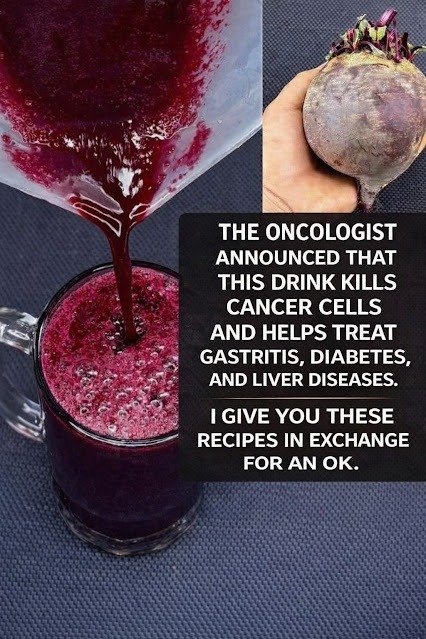
Here is a full, evidence‑based article explaining the claim that “beetroot juice kills cancer cells in 42 days” — and why it’s not true according to current science.
🚫 Beetroot Juice Does Not Kill Cancer Cells in 42 Days
(Fact‑Checked & Debunked)
Social media posts claiming that drinking beetroot juice can kill cancer cells within a fixed period — such as 42 days — are false and misleading. There is no credible scientific evidence supporting this claim. Health experts and independent fact‑checkers have repeatedly debunked similar posts circulating online. (allAfrica.com)
The specific claim — “beetroot juice kills cancer cells in 42 days” — has been widely shared with eye‑catching headlines and images of beet juice, but no reputable scientific studies back it up. (allAfrica.com)
🧬 Why These Claims Spread — And Why They’re Wrong
✔️ Preliminary Lab Findings Do Exist
Beetroot contains natural compounds like betalains, polyphenols, flavonoids, and antioxidants that have shown some anti‑cancer activity in laboratory settings. These include:
- Cytotoxic effects in cell cultures — beetroot extracts can kill or slow the growth of cancer cells in test tubes. (Wisdom Library)
- Animal studies where beetroot compounds reduced tumor growth or supported longer survival in mice. (Wisdom Library)
- Effects on cancer‑related mechanisms, such as triggering apoptosis (programmed cell death) in certain cell lines. (SpringerLink)
However, these results come from in vitro (lab dishes) or in vivo animal experiments — not human clinical trials. That means they do not prove that beetroot juice kills cancer cells in people or can cure cancer. (allAfrica.com)
❌ There Is No Human Evidence
Despite millions of cancer cases and decades of research worldwide:
- No human clinical trial has shown that beetroot juice alone can cure or eliminate cancer. (allAfrica.com)
- No medical authority recommends juice as a cancer treatment.
- A fixed timeline — like “42 days to kill cancer cells” — has no scientific basis. Scientists do not agree on any one timeframe for universally killing cancer cells, even with approved treatments.
🚨 Why the Claim Is Dangerous
Promoting natural foods as miraculous cures can have serious real‑world consequences, such as:
- Delaying proper medical care — cancer can worsen if diagnosis and treatment are postponed. (allAfrica.com)
- Giving false hope to patients and families.
- Encouraging people to substitute proven treatments (chemotherapy, surgery, radiation, immunotherapy) with unproven remedies.
Cancer is a complex group of diseases that requires careful diagnosis and evidence‑based treatment prescribed by qualified healthcare professionals. (allAfrica.com)
🍷 What Beetroot Juice Can Do
Although it does not cure cancer, beetroot juice has some established health benefits when consumed as part of a balanced diet:
- Rich in vitamins, minerals, nitrites and antioxidants, which can support heart health and circulation. (Health)
- May help improve blood pressure and physical performance. (Health)
- Its antioxidant compounds are being researched for potential preventive effects, but not as standalone cures.
🧠 How to Interpret Health Claims Online
When you see dramatic health claims like “42‑day cures” or “natural cancer killer juices”:
- Check the source — is it a scientific journal, reputable health organization, or just a social media post?
- Look for clinical trials in humans — lab studies do not equal real treatment.
- Ask: Has this been published by a peer‑reviewed medical journal? If not, it’s likely not trustworthy.
📌 Bottom Line
✔️ Beetroot juice is nutritious and can be part of a healthy lifestyle.
❌ Beetroot juice has not been proven to cure cancer or kill cancer cells in humans in a set timeframe like 42 days.
❌ Claims that it does are unscientific and misleading. (allAfrica.com)
If you or someone you care about is dealing with cancer, it’s important to follow advice from qualified doctors and oncologists rather than relying on unverified diet claims.
Would you like me to explain how cancer research works and why lab studies don’t mean a cure for humans? (It helps clarify why these claims keep circulating.)
