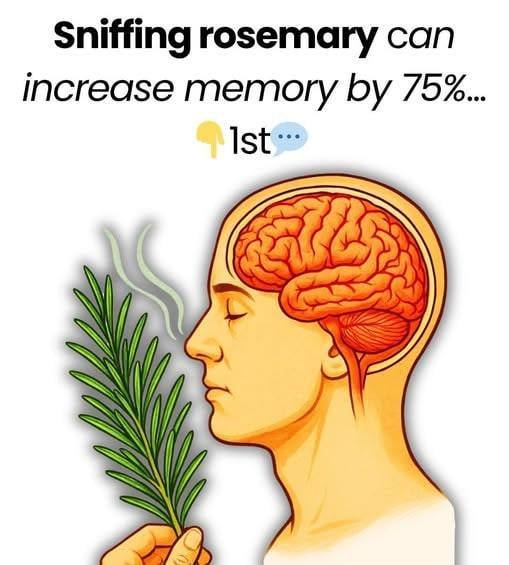
Here’s what science really says about the claim “sniffing rosemary boosts memory by 75%” — and it’s **not as dramatic as the viral headline suggests.
🧪 Origin of the “75% Memory Boost” Claim
The idea comes from reporting around a small 2013 study presented at a scientific meeting in the UK. In that study, participants in a room with rosemary aroma performed better on certain memory tasks than people in an unscented room. Some media outlets boiled that down to a “60 – 75 % increase in memory.” (Snopes)
However, this number is misleading:
- The quoted percentage was based on a rough comparison of task performance differences (e.g., one group finished “seven tasks vs four”). It wasn’t a rigorous measure of overall memory improvement. (Snopes)
- One of the researchers later suggested that if expressed properly the effect might be closer to a single-digit percent, like ~7.5% — not 75%. (Snopes)
- Importantly, the original presentation was not a peer-reviewed published paper, but a conference talk based on a small sample. (Snopes)
So the specific claim that sniffing rosemary boosts memory by 75 % is not supported by solid scientific evidence.
🧠 What Research Does Suggest
There are some scientific studies exploring rosemary and memory, but with important caveats:
Possible mild cognitive effects
- Some experimental studies have found that exposure to rosemary aroma may be associated with slightly better performance on certain memory tasks (like remembering to complete tasks or recalling words), especially in controlled settings. (ScienceDaily)
- One mechanism researchers explore is 1,8-cineole, a compound in rosemary essential oil, which may influence brain chemistry and show up in blood after inhalation. (ScienceDaily)
But…
- These effects are typically small and not consistent enough to say rosemary is a reliable memory enhancer. (Snopes)
- Improvements seen in lab tasks don’t necessarily translate to big changes in real-world memory or everyday functioning. (fullfact.org)
- Larger, peer-reviewed, well-controlled studies are still needed before strong claims can be made. (fullfact.org)
🧠 Why the Myth Spread
Viral articles loved the catchy “75%” figure because it sounds dramatic — but it was basically an oversimplification of preliminary results rather than a validated scientific finding. (Snopes)
🧠 The Bottom Line
- Does sniffing rosemary absolutely increase memory by 75%?
❌ No — that specific figure is exaggerated and not scientifically backed. (Snopes) - Can rosemary aroma possibly influence memory or cognition?
⚠️ Maybe a small amount on certain tasks in specific lab conditions, but far from a proven, large effect. (ScienceDaily) - Should you rely on rosemary scent to dramatically improve memory?
❌ No — stick with proven lifestyle factors like good sleep, balanced diet, exercise, and mental workouts for meaningful memory support. (thip.media)
If you’d like, I can explain how smell and memory are connected in the brain or summarize actual research on rosemary and cognition — just let me know!
