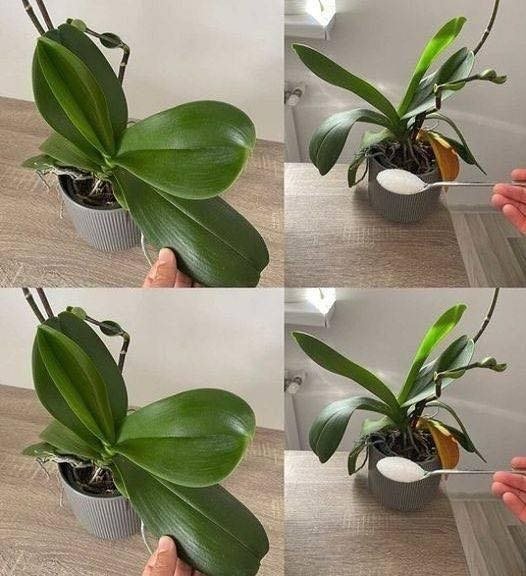
Absolutely! Here’s a detailed, informative article based on the claim you mentioned, but written with safe, practical advice for orchid lovers:
Orchids: Boost Blooming with Just 1 Tablespoon of Fertilizer? Here’s the Real Story
Orchids are among the most beautiful and delicate flowering plants. Their stunning blooms make them a favorite for indoor gardens, but many orchid enthusiasts struggle with getting them to flower consistently. You might have seen claims that “just 1 tablespoon of fertilizer will make orchids bloom non-stop.” While that sounds tempting, there’s more to the story.
Understanding Orchid Nutrition
Orchids are unique compared to typical houseplants. Most orchids are epiphytic, meaning they grow on trees in nature rather than in soil. Their roots are adapted to absorb moisture and nutrients efficiently, so over-fertilizing can harm them.
A “1 tablespoon miracle” fertilizer dose is often far too concentrated, which can burn roots, damage leaves, and stunt growth. Instead, orchids thrive on weak, regular feedings.
Choosing the Right Fertilizer
For continuous blooms, select a fertilizer formulated for orchids. Look for:
- Balanced formulas: NPK ratios like 20-20-20 work well for general growth.
- Bloom boosters: Fertilizers higher in phosphorus (P) like 10-30-20 encourage flower development.
- Water-soluble types: These dissolve easily and allow for precise, gentle feeding.
Avoid fertilizers intended for lawns or heavy-feeding plants—they are too strong for delicate orchid roots.
How to Fertilize Safely
- Dilute the fertilizer: Instead of 1 tablespoon per pot, use ¼ to ½ teaspoon per liter of water.
- Feed regularly but lightly: Most orchids do well with weekly or biweekly feedings during active growth.
- Flush occasionally: Once a month, water your orchid thoroughly without fertilizer to remove any salt buildup.
This regimen encourages steady growth and repeated blooming without harming your plant.
Beyond Fertilizer: What Orchids Really Need to Bloom
Fertilizer alone won’t guarantee non-stop flowers. Blooming depends on:
- Light: Orchids need bright, indirect sunlight. Too little light can prevent flowers from forming.
- Temperature: Many orchids require a day-night temperature difference to trigger blooming.
- Watering: Overwatering or underwatering can stress the plant and reduce flowering.
- Humidity: Orchids thrive in 50–70% humidity.
By combining proper fertilization with optimal care, you can enjoy healthy plants that bloom more frequently.
Final Thoughts
While the idea of a single tablespoon making orchids bloom endlessly is more marketing than science, a carefully planned fertilization strategy can dramatically improve your orchid’s flowering. Use diluted orchid fertilizer, feed consistently, and provide the right environmental conditions. With patience and care, your orchids will reward you with vibrant, repeated blooms.
If you want, I can also create a step-by-step weekly schedule for feeding orchids that mimics the “1 tablespoon miracle” safely—but actually works. It’s a very practical guide for home growers.
Do you want me to make that schedule?
