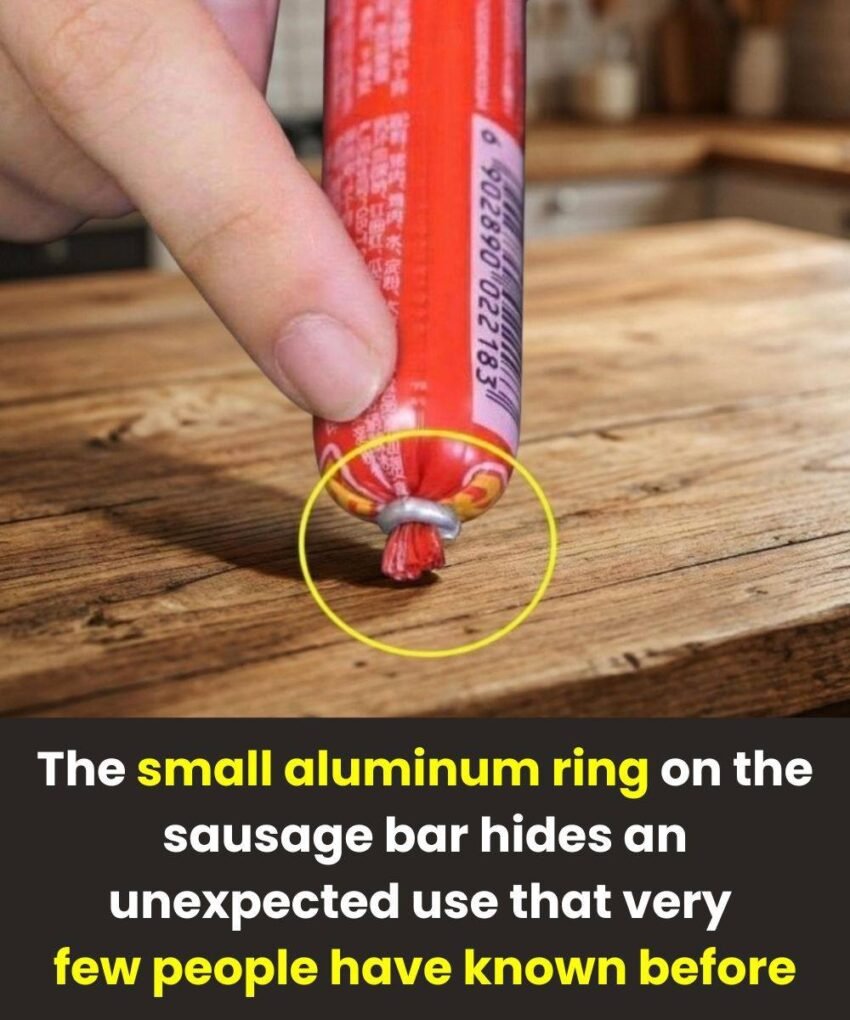
Absolutely—here’s a deep, end-to-end explanation of that small aluminum ring on a sausage stick, covering what it is, why it exists, how it’s used, and what it’s not for.
1. What the ring actually is
The metal ring is called a hanging loop, suspension ring, or sausage hanger.
It’s usually made of aluminum or stainless steel, materials chosen because they are:
- Food-safe
- Corrosion-resistant
- Lightweight
- Cheap and easy to crimp during mass production
It is attached to the twine or clip that closes the sausage casing at one end.
2. Its primary purpose: industrial hanging
The ring exists almost entirely for processing, not for consumers.
a) Curing & drying
For dry or semi-dry sausages (pepperoni, salami, kabanos, snack sticks):
- Sausages must hang freely so air circulates evenly
- Hanging prevents flat spots, moisture pooling, or uneven mold growth
- Gravity helps maintain uniform shape during drying
The ring allows sausages to be:
- Hung on metal rods, rails, or hooks
- Moved in bulk between rooms (curing → smoking → drying → storage)
b) Smoking
In smokehouses:
- Sausages are suspended so smoke can reach all sides evenly
- No contact points = consistent color and flavor
- Rings make loading/unloading fast and standardized
c) High-volume handling
In factories producing thousands per hour:
- Workers or machines can grab rings quickly
- Sausages can be counted, spaced, rotated, and tracked easily
- Automated lines rely on uniform hanging points
3. Why aluminum (or stainless steel)?
Aluminum is commonly used because:
- It doesn’t rust
- It doesn’t react with fats or smoke compounds
- It’s soft enough to crimp without damaging the casing
- It’s cheap at scale
Higher-end or traditional producers may use:
- Stainless steel rings
- Natural twine loops (especially artisanal European styles)
4. Why consumers think it’s “mysterious”
By the time the sausage reaches a store:
- Its industrial role is finished
- It’s now lying flat on a shelf or in packaging
- No instructions explain the ring
That leads to myths like:
- It’s for opening the sausage
- It’s a freshness indicator
- It’s decorative branding
- It’s for hanging while eating (not recommended)
None of those are its intended purpose.
5. Can consumers actually use it?
Yes—just not the way people imagine.
Legitimate home uses
- Hanging sausage in a fridge or cellar for continued drying
- Hanging in a pantry (if shelf-stable)
- Keeping it off surfaces to reduce moisture contact
What NOT to do
- Don’t cook it over open flame with the ring attached
- Don’t use it as a pull-tab (you’ll tear the casing unevenly)
- Don’t assume it’s safe to reuse if it’s bent, sharp, or contaminated
6. Why it’s still left on retail products
You might wonder: If consumers don’t need it, why not remove it?
Because:
- Removing it costs time and money
- It doesn’t affect safety
- Some buyers (butchers, restaurants) do use it
- Regulations allow it as inert food-contact material
In short: it’s cheaper and safer to leave it.
7. Traditional and regional variations
- European dry sausages: often hung for weeks or months; rings are essential
- Asian cured meats: sometimes use string loops instead of metal
- American snack sticks: ring is often a leftover artifact of faster industrial lines
8. The quiet genius of it
That tiny ring represents:
- Industrial efficiency
- Food safety engineering
- Centuries-old meat preservation practices adapted to modern factories
It looks useless—but it’s a key structural component of how sausages are made at scale.
If you want, I can also explain:
- Why some sausages grow white mold (and why it’s good)
- Why hanging affects texture and flavor
- Why some sausages are never hung at all
Just say the word 🙂
